
RTX Lands $22.9 Billion Tomahawk Contract as U.S. Moves to Rebuild Missile Stockpiles
The seven-year award is designed to support annual production of more than 1,000 Tomahawks, giving RTX long-term demand visibility as the United States works to restore missile inventories.
Our editorial standards
MarketReview publishes clear, independently produced financial information using reliable sources and transparent editorial standards.
Read our Editorial Policy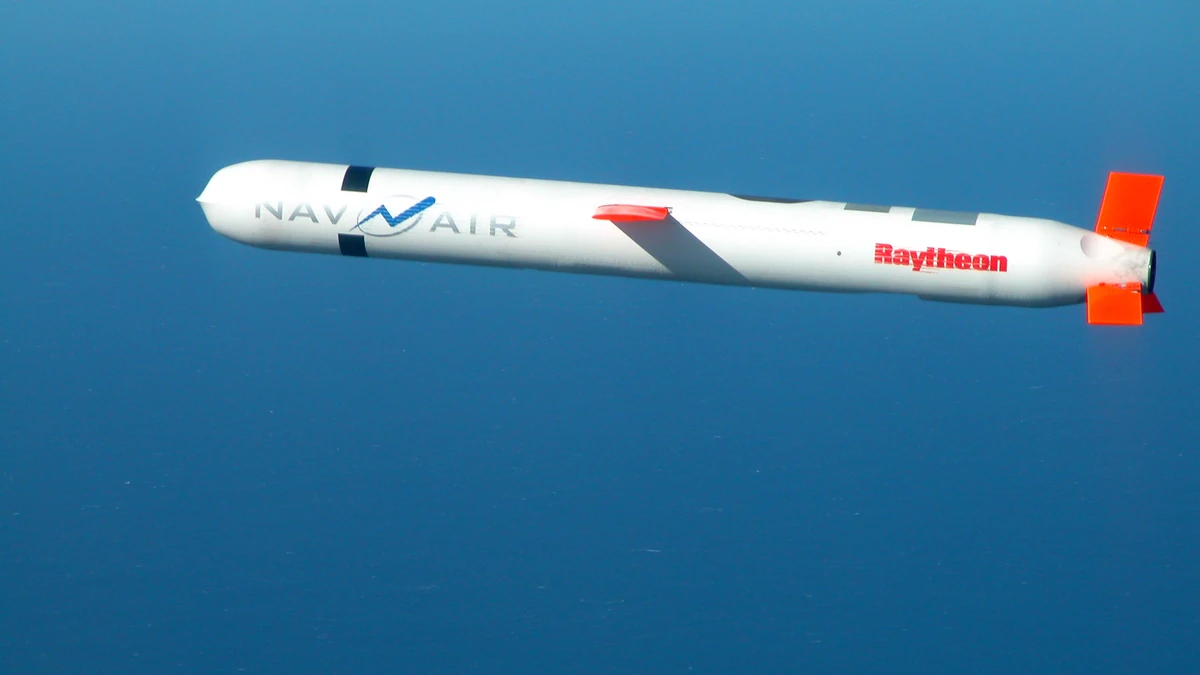
The U.S. Navy awarded Raytheon, an RTX business, a contract valued at $22.9 billion to expand Tomahawk cruise missile production, formalizing a seven-year arrangement intended to support annual output of more than 1,000 missiles. The award gives RTX a large, long-duration demand signal as the United States tries to rebuild munitions inventories and create more capacity for future requirements.
The headline value needs an important qualification. The Navy describes the award as a $22.9 billion contract, and RTX describes it as a seven-year contract covering Tomahawk missiles and associated support. Neither Monday release specifies how much money was obligated at signing, the exact number of missiles that will be ordered under the award, the annual ordering profile, or how much of the total value will be recognized in RTX’s backlog immediately. The full $22.9 billion therefore should not be read as current-period revenue or as a cash payment to RTX on the award date.
The Navy said the contract is intended to reduce procurement lead times and speed delivery of a weapon used for long-range strike missions from ships and submarines. The agreement also turns an earlier production framework into a concrete procurement commitment at a time when U.S. officials have been pressing defense contractors to add manufacturing capacity rather than rely on short bursts of annual orders.
Seven years of orders are meant to make capacity investable
For RTX, the commercial importance of the award is not only the size of the contract. It is also the duration. Defense manufacturers generally need confidence that higher demand will persist before hiring workers, adding equipment, expanding plants and asking suppliers to do the same. The Navy said longer-term stability and predictability are intended to support workforce capacity, manufacturing throughput and stronger supply chains.
RTX said the new contract supports a ramp to more than 1,000 Tomahawks a year. The company had already agreed in February to framework agreements with the U.S. government covering up to seven years for several critical munitions programs, including Tomahawk, AMRAAM, SM-3 and SM-6. For Tomahawk specifically, that framework contemplated annual production above 1,000 missiles across the land-attack and maritime-strike families.
The August award makes the Tomahawk portion of that industrial-base strategy much more tangible. RTX said it delivered three times as many Tomahawks in the first half of 2026 as it did in the first half of 2025. It also said the next phase will require further investment in its workforce, technology, supply chain and facilities, along with coordination across hundreds of small and medium-sized suppliers.
That production target should not be confused with an immediate delivery rate. RTX did not say in Monday’s announcement when annual output will cross 1,000, and the Navy did not publish a year-by-year delivery schedule. Building capacity can require new machinery, qualified labor, supplier expansion and testing throughput before additional missiles reach the customer. The seven-year term is designed in part to give the industrial base enough visibility to make those investments. It also illustrates how procurement policy is changing around munitions: instead of treating each year’s purchase as a largely separate decision, the government is using longer commitments to give manufacturers a clearer demand horizon. For RTX, that can make capital deployment easier to justify. For the Navy, the goal is to turn contractual demand into physical production capacity and shorter lead times.
Rebuilding inventories will still take years
The production push comes against a much tighter inventory backdrop than existed when many U.S. missile lines were sized for relatively modest peacetime procurement. Reuters reported Monday that the U.S. military is trying to rebuild depleted stocks after weapons supplied to allies and missiles used in the conflict with Iran increased concern about available inventories. Exact U.S. Tomahawk stockpile levels are not publicly disclosed, so estimates of depletion and replenishment should be treated as estimates rather than official inventory counts.
The Navy’s own fiscal 2027 budget discussion shows the scale of the attempted change. At a budget briefing earlier this year, Rear Adm. Ben Reynolds was asked about a planned jump to 785 Tomahawks. He said the Navy intended to procure all 785 in fiscal 2027 and acknowledged that expanding the weapons industrial base would be a challenge. He also said Raytheon would need to invest heavily to increase production.
That procurement ambition is far above the recent historical pace. A May analysis by the Center for Strategic and International Studies estimated that Tomahawk procurement averaged about 86 missiles a year from fiscal 2015 through fiscal 2026 and that recent annual production had been below 200. CSIS estimated that, under the production assumptions available at the time, restoring Tomahawk inventories to prewar levels would take at least three years. Those figures are outside estimates built from public procurement data, not official disclosures of classified stockpile levels.
The gap between a contract award and a replenished magazine is central to understanding Monday’s announcement. A seven-year, $22.9 billion commitment can support factories, suppliers and labor over a much longer horizon, but it does not instantly replace missiles that have already been used. The physical constraint is throughput. Specialized components must arrive in sequence, and finished weapons still have to be assembled, tested and accepted before they reach operational inventories.
The Navy’s release focuses directly on that bottleneck. It says the award is intended to reduce lead times and support rapid fielding, and it describes the broader effort as an expansion of the munitions industrial base. The result is that the contract should be viewed as both a procurement action and an industrial-capacity action. The missiles themselves are the end product, but the government is also buying enough demand certainty to encourage a larger production system.
The deal strengthens RTX’s defense demand, but revenue will arrive over time
For investors, the contract adds another large defense award to an already sizable RTX order base. RTX reported $119 billion of defense backlog at the end of the second quarter. Raytheon, the company’s defense segment, generated $8.27 billion of second-quarter sales and $1.04 billion of operating profit, with sales up 18% from a year earlier and operating profit up 29%.
The Tomahawk award is large even in that context, but the seven-year term matters more than a comparison with a single quarter. Contract value, backlog, sales and cash collection are different measures. Monday’s announcements do not state how much of the $22.9 billion will be booked immediately, when individual orders will become firm, or how revenue will be distributed over the seven-year period. They also do not provide a profit-margin target for the work.
What the award does provide is longer visibility for a production line that RTX is already expanding. Higher sustained output can spread manufacturing investment over more units and create a steadier workload for suppliers, but the economic benefit depends on execution. RTX still has to bring capacity online, keep suppliers synchronized and deliver missiles at the pace the Navy expects. The contract’s headline value alone does not establish how profitable that ramp will be. The strategic logic is stronger than a simple “more missile sales” reading because Tomahawk is already fielded from U.S. Navy surface ships and submarines. Replenishment demand is tied to an existing force structure rather than a new platform program, and a multi-year commitment gives RTX reason to build for a higher baseline of demand rather than a temporary surge.
For the Navy, the test will be whether the award materially shortens lead times and pushes production toward the stated rate of more than 1,000 Tomahawks a year. For RTX shareholders, the key questions are how quickly the contract converts into funded orders, backlog and revenue, and how much capital the company must deploy to get there. Those details were not disclosed in Monday’s announcements, so the $22.9 billion figure establishes the scale of the opportunity more clearly than it establishes the near-term earnings impact.
More News



Latest News
View all news- U.S. Commerce Department Finalizes South Korean Hot-Rolled Steel Subsidy Review
- Treasury Names Judy Shelton Counselor on Currency Policy, With China Focus
- U.S. Opens Proposed Gulf Offshore Oil and Gas Lease Sale 4 for Review
- Federal Reserve Reports Rising Household Financial Stress Despite Gains in Income and Wealth
- Canada Employment Falls in September as Unemployment Rises to 6.5%
