Swiss Agricultural Value Added Forecast to Fall 11.7% in 2026 After Severe Drought
Drought-hit crops and a pork-market glut are weighing on farm output, with Swiss agricultural sector income forecast to fall 17%.
Our editorial standards
MarketReview publishes clear, independently produced financial information using reliable sources and transparent editorial standards.
Read our Editorial Policy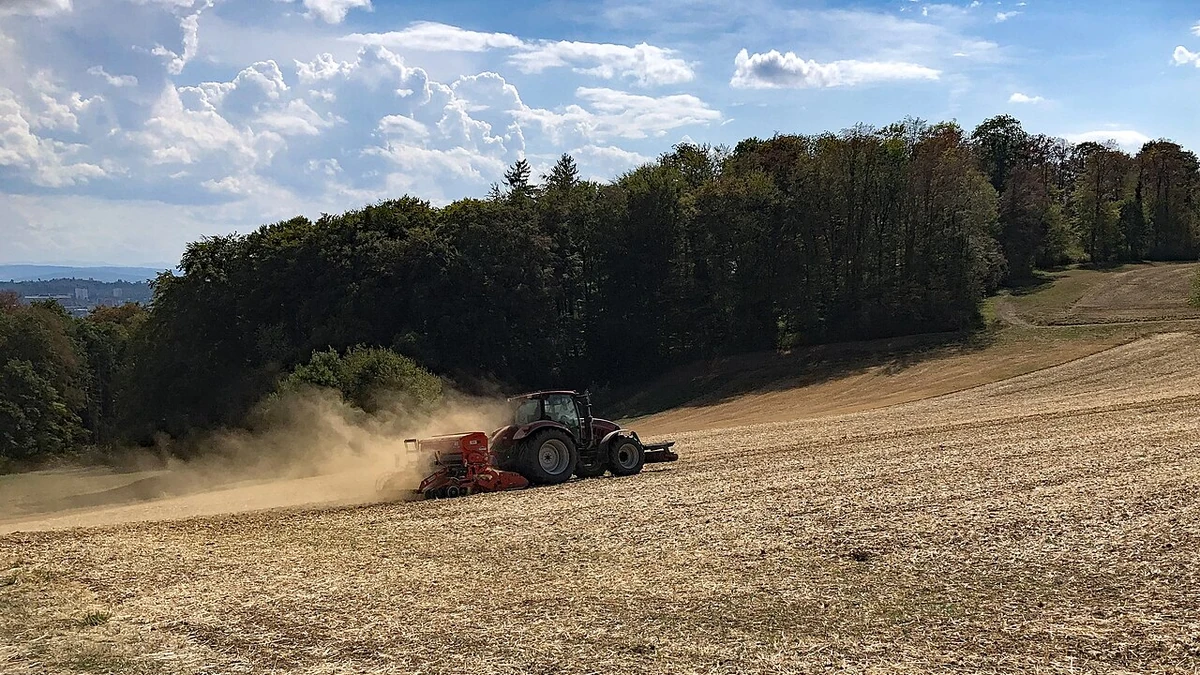
Switzerland’s agricultural sector is forecast to generate CHF 4.5 billion in gross value added in 2026, an 11.7% decline from the previous year, after prolonged drought damaged crops and a glut of pork drove prices sharply lower. The Federal Statistical Office released the preliminary estimate on Tuesday, putting numbers on a difficult year for producers following an unusually strong 2025.
The value of agricultural output is expected to fall 5.1% to CHF 12.0 billion, but spending on intermediate goods and services such as feed, energy and fertilizer is projected to ease by just 0.5% to CHF 7.5 billion. That imbalance helps explain why value added, which subtracts those production inputs from output, is falling more steeply than farm output itself.
The 11.7% decline is measured at current prices. Stripping out price changes, agricultural gross value added is projected to fall 2.2%, according to the Federal Statistical Office’s detailed economic accounts. The difference is important: the headline percentage does not mean the physical volume of Swiss agricultural production has shrunk by the same amount. These are initial estimates for the year, rather than final results.
Dry conditions hit fodder, potatoes and sugar beet
Crop production bears much of the weather-related damage. Its value is forecast to decline 9.0% to CHF 4.0 billion after high summer temperatures and persistent dryness reduced yields across several major crops and grassland. The conditions were not uniformly bad for every harvest. Grain was collected early and performed well, and irrigated vegetable and horticultural production was less exposed than fields dependent on rainfall.
The value of fodder production is estimated to have fallen 19.2%, reflecting poor harvests and the early use of stored feed reserves. Sugar beet production value is projected to drop 33.0% and potato production value 24.8%. The statistical office describes those harvests as the weakest in roughly three decades, showing how a summer of limited moisture translated into sharp losses for crops that had more difficulty coping with the conditions.
Fruit and wine also contributed to the decline, although their circumstances were different. The value of fruit output is estimated to be 8.3% lower after two productive years in 2024 and 2025. The grape harvest was assessed as very good in quality but smaller than in 2025, and average prices for grapes and wine also decreased. Together those factors are expected to reduce the value of wine production by 8.8%.
The feed shortage reaches beyond the crop figures. Milk output initially benefited from plentiful fodder produced in 2025, then fell back in the second half of 2026 as drought made feed scarcer. For the full year, milk volumes are expected to be broadly unchanged. Yet the value of milk production is forecast to decline 4.8% to CHF 2.7 billion because the average milk price is also estimated to fall 4.8%. Farmers therefore faced both a physical feed constraint and weaker selling prices.
Pork price collapse deepens the loss in livestock revenue
Livestock production as a whole is expected to generate CHF 6.2 billion, down 3.9% from 2025. Pork is a major reason. Supply increased 5.3% even as demand failed to absorb the additional volume, pushing pig prices down 34.3%. The value of pork production consequently is estimated to plunge 30.8% to CHF 0.7 billion. Unlike damage to fields and pasture, the pork-market weakness reflects an imbalance between supply and demand, not a direct measure of drought losses.
Other animal products provide a striking contrast. Cattle production value is forecast to rise 10.6% to CHF 1.8 billion, its highest level since the early 1990s. The market for larger slaughter cattle benefited from both higher volumes sold and better prices than a year earlier. Demand for Swiss eggs also remained firm, with egg production value expected to grow 4.1% to CHF 0.4 billion.
Those differences matter when assessing the effect on farm businesses. A cattle producer selling into a stronger market faced a different revenue picture from a pig farmer dealing with collapsing prices or a grower whose potato crop was damaged by drought. National economic accounts combine these businesses into one sector figure; they do not indicate that every Swiss farm experienced an 11.7% fall in its own value added.
Prices are central to the broader agricultural result. The estimated fall in milk revenue comes largely from weaker pricing despite little change in annual milk volume, whereas the pork decline reflects a large drop in prices alongside greater supply. Crop losses include substantial reductions in harvests. Together, these distinct pressures produced a decline in the value of total output that was more severe than the price-adjusted change in gross value added.
Sector income falls as costs remain elevated
The pressure becomes more apparent further down the agricultural accounts. Total sector resources, consisting of production value, government payments and interest income, are forecast at CHF 15.0 billion, down 4.0%. Production expenses are expected to fall only 0.4% to CHF 12.2 billion. Net entrepreneurial income, the amount primarily available to compensate farming families for their own work and productive assets, is therefore estimated at CHF 2.8 billion, a 17.0% decline from 2025.
That projected sector income is 4.5% below the average for the previous five years. It is a different measure from gross value added: the sector-income calculation also reflects expenses such as depreciation, employee compensation, rent and interest. For readers comparing the figures, the 11.7% fall in value added and the 17.0% fall in entrepreneurial income describe different stages of the same agricultural accounts, not conflicting estimates.
Direct government payments remain an important part of the sector’s finances. They are expected to total CHF 3.0 billion, an increase of 0.4% from 2025, and account for one-fifth of the resources recorded for agriculture. Switzerland has long used these payments to compensate farms for services considered to be in the public interest. The estimate does not describe them as a new drought-relief program, but their scale helps explain why sector resources are larger than the value of farm output alone.
The modest decline in overall production expenses conceals sharply different movements in individual costs. Feed costs are estimated to fall 5.2%, even though farms have been drawing down supplies. At the same time, the statistical office estimates price increases of 15.6% for fuel and heating materials, 7.9% for fertilizer and 31.4% for water. A lower aggregate bill therefore should not be mistaken for an absence of cost pressure across the sector.
Depreciation is projected to decrease 0.8% to CHF 2.2 billion, mainly reflecting reduced investment in buildings and machinery in recent years. Employee compensation is expected to fall 0.6% to CHF 1.7 billion even as average wages rise 0.7%, because the volume of paid work is lower. Across agriculture more broadly, the estimated labor input declines 1.5% and labor productivity 0.7%, although productivity remains 38% above its 2000 level.
The effects of the drought may outlast the accounting year. The statistical office expects the full impact of feed scarcity to become apparent only in 2027, after farms have already used some of their reserves. That leaves a practical pressure on livestock producers even as the 2026 estimates show relatively little change in total intermediate-input spending. The agency has not provided a value-added forecast for 2027 in this release.
More News



Latest News
View all news- Spain’s Sánchez Proposes Bank Tax Extension to Raise €1.4 Billion for Housing
- Canada Announces C$248,063 Investment to Restore Nova Scotia Lighthouse and Support Tourism
- New York’s New CPA Licensing Law Takes Effect, Adding 120-Credit Pathway
- Nasdaq Rule Removing CORE FIX Order-Entry References Becomes Operative
- Monte dei Paschi Calls Intesa Takeover Offer Financially Fair but Says It Undervalues Future Potential