
U.S. Leading Economic Index Was Flat in September as Growth Tilts Toward Business Investment
The Conference Board said the U.S. Leading Economic Index was unchanged at 99.6 in September, while its six-month trend improved and the growth outlook tilted further toward business investment.
Our editorial standards
MarketReview publishes clear, independently produced financial information using reliable sources and transparent editorial standards.
Read our Editorial Policy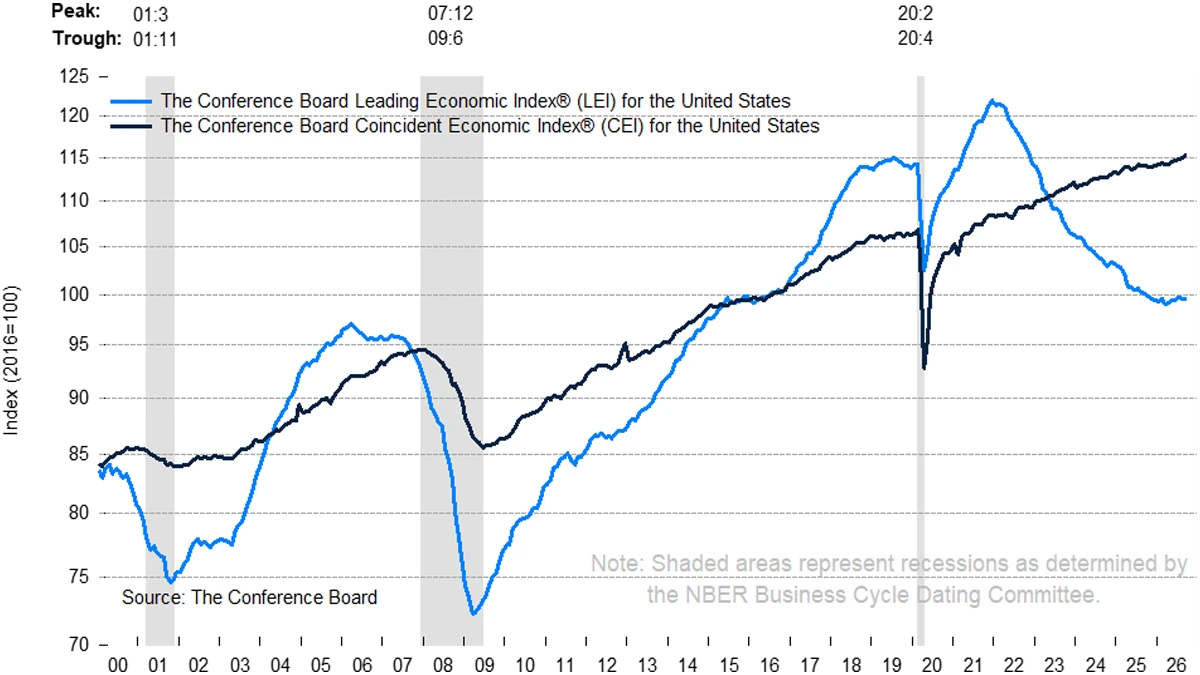
The U.S. Leading Economic Index was unchanged in September, a modest result on its face but one that still pointed to continued expansion rather than an imminent downturn. The Conference Board said the index held at 99.6, measured on a 2016=100 basis, after slipping 0.1% in August.
That flat monthly reading came with a better medium-term backdrop. Over the six months from March through September, the index rose 0.6%, reversing a 1.1% decline over the prior six-month stretch. The improvement does not mean the economy is accelerating across the board, but it does suggest the earlier loss of momentum has eased.
Current-condition data looked firmer than the headline leading reading. The Conference Board Coincident Economic Index rose 0.3% in September to 115.3 after a 0.1% increase in August, and all four of its components contributed positively. The organization also said it now expects real U.S. GDP to grow at a 2.2% annualized rate in 2026 and 2.0% in 2027, both higher than it had previously forecast.
A flat September reading masked a better six-month trend
In its October 22 release, The Conference Board described the September result as flat but emphasized that an upward revision to July left the index at a somewhat higher level than the prior month’s report had shown. That matters because the LEI is designed to look ahead, not merely summarize what happened in the latest month. Small monthly changes can be noisy, while the six-month rate often provides the clearer signal.
The LEI combines 10 forward-looking components, including manufacturing hours, jobless claims, new orders, stock prices, building permits, credit conditions, the yield curve and consumer expectations. It is meant to flag turning points in the business cycle roughly seven months ahead. September’s unchanged reading therefore needs to be read alongside the broader trend, which has turned positive again after weakening through late 2025 and early 2026.
Alongside the LEI, The Conference Board’s coincident index continued to move higher. Because the CEI tracks payroll employment, personal income excluding transfer payments, manufacturing and trade sales, and industrial production, it tends to line up closely with what the economy is doing now. A positive reading there, coupled with a flat but improved LEI, supports the view that activity is still expanding even if the pace remains uneven.
Support came from rates and factory hours, while consumers weakened
Five of the 10 leading-index components made positive contributions in September. The largest help came from the interest rate spread and average weekly hours in manufacturing. A healthier spread can signal improved financial conditions, while longer factory workweeks can suggest manufacturers still need labor time to meet demand.
Those positives, however, were not broad enough to produce a monthly increase. The Conference Board said the biggest drag came from a steep fall in consumer expectations. Smaller negative contributions came from stock prices, building permits and new orders for capital goods. That mix is important for interpreting the report: September’s steady headline number was not driven by a clear rebound in households or in every investment-sensitive indicator.
The capital-goods detail is especially worth handling carefully. The same release that pointed to a more investment-led growth mix also said new orders for capital goods made a negative contribution to the September LEI. In other words, The Conference Board was not saying that business investment directly lifted the monthly index reading. Its point was broader: as consumer spending softens, business outlays are likely to play a larger role in keeping the expansion going.
That distinction helps avoid overstating what one month’s reading can tell us. Consumer attitudes can swing sharply, stock prices can reverse, and permits or orders often move unevenly from month to month. What September showed was a balance between supportive financial and manufacturing signals on one side and weaker household sentiment and selected demand indicators on the other.
The report still did not signal a recession
The Conference Board also said its recession-warning framework did not flash in September. Under its so-called 3D approach, a recession signal requires both a sufficiently deep six-month decline in the LEI and weak enough breadth among the index’s components. Specifically, the six-month annualized growth rate must fall below a defined threshold and the diffusion index must fall to 50 or lower.
That did not happen in September. The six-month growth rate improved further and the diffusion index moved slightly above 50, according to the release. For readers trying to interpret the report beyond the headline, that may be the most important takeaway. A flat monthly reading can sound stagnant, but in this case the underlying recession test remained in expansion territory.
The lagging index also moved higher, rising 0.5% in September to 121.1 after a 0.2% increase in August. Lagging measures are less useful as early warning tools, but they can still help confirm the broader backdrop. Taken together, the leading, coincident and lagging indexes painted a picture of an economy that has cooled from earlier strength yet is still advancing.
Why business investment is taking on a bigger role
The Conference Board said the economy is becoming less dependent on consumer spending and more dependent on business investment. That observation fits a period in which households have become more constrained and companies, while selective, are still spending in areas tied to productivity, capacity and long-term expansion.
Official national-output data offer some support for that broader interpretation. In its latest second estimate for second-quarter GDP, the Bureau of Economic Analysis said real GDP grew at a 1.5% annual rate, with consumer spending, exports and investment all contributing to the increase. BEA also said real final sales to private domestic purchasers, a measure that combines consumer spending and gross private fixed investment, rose 4.2% in the quarter.
That does not mean investment is uniformly strong everywhere. The Conference Board’s own September breakdown showed weakness in capital-goods orders, and recent Census Bureau manufacturing reports have also pointed to patchy order trends rather than a straight-line upswing. Still, the larger message from Thursday’s LEI release was that business investment may carry a larger share of the growth burden if household demand loses momentum.
For investors, policymakers and business planners, that shift changes what matters in upcoming data. Instead of looking only at consumer sentiment or retail-related indicators, it will be increasingly important to watch measures tied to capital spending, factory activity and broader corporate demand. If those remain resilient, the economy could keep growing even with softer household spending.
The next scheduled release for The Conference Board’s U.S. leading indicators is November 19 at 10 a.m. ET. By then, markets will also have fresh third-quarter GDP data from the government, giving a clearer view of whether investment is in fact picking up more of the economy’s forward momentum.
More News



Latest News
View all news- Union Pacific Third-Quarter Profit Rises 16% to $2.1 Billion as Freight Volumes Grow
- Nasdaq Q3 Revenue Jumps 13% as Annual Recurring Revenue Reaches $3.4 Billion
- Blackstone Reports Third-Quarter Earnings With Assets Under Management Near $1.4 Trillion
- BEA Expands State-Level R&D Economic Statistics With New 2024 Estimates
- Sweden’s Economy Grows 3.8% as Greenhouse Gas Emissions Decline, New Data Show
