
U.S. Inflation Rises 0.1% in July as Annual CPI Rate Eases to 3.4%
Core CPI rose 0.2% while energy prices fell 1.5%, giving the Fed a cooler inflation reading after a divided July policy vote.
Our editorial standards
MarketReview publishes clear, independently produced financial information using reliable sources and transparent editorial standards.
Read our Editorial Policy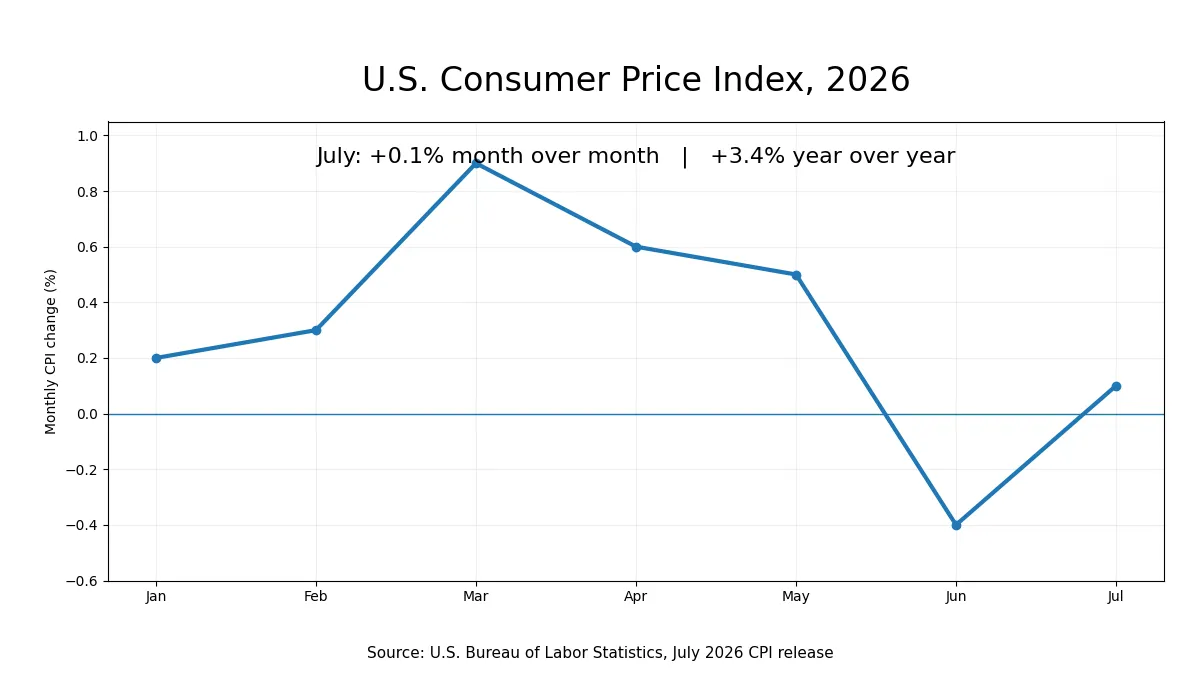
U.S. consumer prices rose only 0.1% in July after falling 0.4% in June, while the annual inflation rate eased to 3.4% from 3.5%, according to the Bureau of Labor Statistics. The modest monthly increase gives the Federal Reserve a somewhat cooler inflation reading, but it does not settle the policy debate with inflation still running above the central bank’s 2% goal.
Core prices, which exclude food and energy, rose 0.2% in July after being unchanged in June. The core index increased 2.5% over the past 12 months, down from 2.6% in June. Both the headline and core annual rates therefore moved lower, even as some service categories continued to rise.
The July CPI report showed that shelter accounted for roughly two-thirds of the monthly increase in the all-items index. Food prices edged higher, while lower energy prices provided the main offset.
Shelter keeps rising as energy prices fall
Shelter prices increased 0.1% in July and were up 3.2% from a year earlier. Within the category, both rent and owners’ equivalent rent rose 0.3% over the month, while lodging away from home fell 2.8%. Housing costs therefore remained a source of inflation pressure even though the monthly shelter increase was relatively small.
Energy moved in the opposite direction. The energy index fell 1.5% in July after dropping 5.7% in June, with gasoline prices down 2.9% on a seasonally adjusted basis. Electricity rose 0.1% and utility gas service increased 0.7%.
The monthly decline in energy helped restrain headline CPI, but the year-over-year comparison remains much less comfortable for consumers. Energy prices were 14.7% higher than a year earlier, while gasoline was up 24.6% over the same period. That split is important: falling energy prices helped July’s monthly inflation number, but households were still paying substantially more for energy than they were a year ago.
Food prices rose 0.1% in July. Grocery prices declined 0.1%, while food away from home increased 0.3%. Over the past year, food at home was up 2.7% and food away from home rose 3.4%, leaving restaurant inflation slightly above the overall food rate.
The consumer picture also looks less favorable when inflation is compared with wages. A separate BLS release showed that real average hourly earnings for all employees fell 0.1% from June to July after adjusting for inflation. Real average weekly earnings were unchanged over the month, and real average hourly earnings were 0.2% lower than a year earlier. The softer CPI print therefore did not translate into a broad improvement in inflation-adjusted hourly pay in July.
Core inflation eases, but services remain uneven
The 0.2% rise in core CPI was moderate, but the underlying details were mixed. Medical care increased 0.4% in July, airline fares rose 2.2%, communication prices increased 0.6%, education rose 0.5% and recreation increased 0.2%. Used cars and trucks rose 0.4%, while motor vehicle insurance fell 0.3% after a 2.0% decline in June.
Services excluding energy services rose 0.2% in July and were up 3.0% over the past 12 months. Commodities excluding food and energy commodities also rose 0.2% over the month, but were only 0.8% higher than a year earlier. That difference shows why the inflation debate remains centered heavily on services and housing rather than broad-based goods inflation.
The annual core CPI rate of 2.5% is now closer to the Fed’s 2% objective than the headline rate, but the comparison is not exact because the Fed formally targets inflation measured by the personal consumption expenditures price index, not CPI. The latest available PCE data, for June, showed a 3.7% increase from a year earlier. The Bureau of Economic Analysis is scheduled to release July PCE data on August 26.
The report lands in a divided Fed debate
The timing of the CPI report matters because Federal Reserve officials were unusually divided at their most recent policy meeting. On July 29, the Federal Open Market Committee kept the federal funds target range at 3.50% to 3.75% by a 9-3 vote. Beth Hammack, Neel Kashkari and Lorie Logan dissented because they preferred a quarter-point rate increase.
The Fed’s statement said inflation remained elevated relative to its 2% goal and pointed to supply shocks that had lifted prices in some sectors, including energy. July’s CPI data offer some evidence that near-term price pressure cooled, especially through lower energy prices and a further decline in the annual core rate. At the same time, the 14.7% year-over-year increase in energy and continued gains in shelter and several service categories give policymakers reasons to remain cautious.
The inflation report also arrives after a softer July employment report. Nonfarm payroll employment changed little at minus 23,000, the unemployment rate was 4.1%, and BLS revised May and June payroll gains down by a combined 103,000 jobs. Those figures do not point to an economy with uniformly strong labor demand, adding another consideration for a Fed that is balancing inflation against employment conditions.
Fed officials had already marked up their inflation projections in June. The median participant projected 2026 PCE inflation at 3.6% and core PCE inflation at 3.3%, while the median projected federal funds rate at the end of 2026 was 3.8%. Those projections were made before the latest employment and CPI releases, so they are not a forecast of what the Fed will decide in September.
Taken together, the July CPI figures reduce one source of pressure for an immediate rate increase, but they do not establish that inflation is back at the Fed’s goal or that rate cuts are imminent. Policymakers will receive July PCE data on August 26 and another CPI report on September 11 before the next scheduled FOMC meeting on September 15-16.
More News



Latest News
View all news- Spain Publishes €3.6 Million Export Grant Call for Small and Medium-Sized Businesses
- UK Defence Ministry and QinetiQ Launch Project Safari to Expand Smaller Firms’ Access to Military Testing
- Phoenix Education Names Michael Cochran Interim CFO as Finance Leadership Change Takes Effect
- India Outlines Over ₹13,000 Crore in Projects for October 11
- EU Urges U.S. to Reverse Sanctions on International Criminal Court, Signals Readiness to Protect Its Operations
