Canada Employment Falls in September as Unemployment Rises to 6.5%
The 68,000-job decline was the second straight monthly drop, with younger workers and public-sector employees bearing much of the weakness.
Our editorial standards
MarketReview publishes clear, independently produced financial information using reliable sources and transparent editorial standards.
Read our Editorial Policy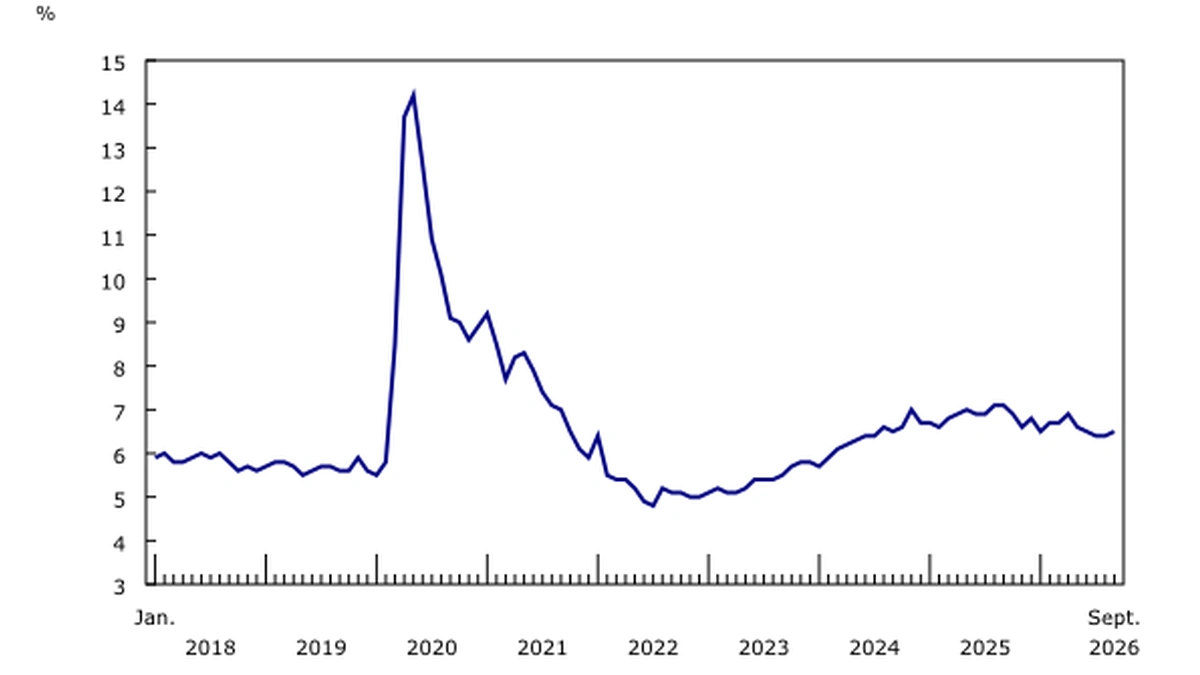
Canada’s employment fell by 68,000 in September, the second consecutive monthly decline, as the unemployment rate rose to 6.5% from 6.4% in August. The losses were concentrated among younger workers, while a renewed contraction in public-sector employment added to the weakness.
The 0.3% decrease left 21.105 million people employed, according to figures released Friday, October 9. Full-time employment declined by 35,000 and part-time employment by 33,000. With August’s 42,000-job decline, Canada has shed roughly 110,000 jobs over two months, giving back more than half of the 181,000 gained from April through July.
The employment rate, which measures the share of people aged 15 and older who have jobs, fell by 0.2 percentage points to 60.6%. Employment was still 95,000 higher than a year earlier, a reminder that the sharp monthly decline sits alongside modest growth over the past 12 months. Statistics Canada’s September Labour Force Survey also showed that the unemployment rate had returned to its January level after reaching 6.9% in April and falling to 6.4% in July and August.
Quebec accounts for the largest provincial decline
The national figures mask sharply different labour-market performances across Canada. Quebec lost 49,000 jobs in September, a 1.1% decline, after a decrease of 19,000 in August. Employment in the province has fallen by a cumulative 130,000 since January, and its unemployment rate climbed by 0.4 percentage points in September to 6.0%.
British Columbia recorded a loss of 20,000 jobs, or 0.7%, bringing its employment rate down to 60.5%. Its unemployment rate was little changed at 6.4%. Ontario’s employment edged down by 20,000, although the province still had 86,000 more people working than a year before. Ontario’s jobless rate was 7.0%, little changed on the month.
Alberta went in the opposite direction, adding 23,000 jobs in September. Its unemployment rate fell by 0.4 percentage points to 6.4%, while employment was 76,000 higher than in September 2025. Manitoba lost 4,400 jobs, and smaller gains were reported in Newfoundland and Labrador and Prince Edward Island. The provincial split shows why the national decline should not be read as an equally weak hiring environment everywhere.
Young workers lose jobs, but many also leave the labour force
Employment among Canadians aged 15 to 24 declined by 48,000, or 1.8%, following another drop in August. The two-month reduction of 67,000 erased the gains made by young workers from April through July. Yet the youth unemployment rate was little changed at 13.0%, partly reflecting the fact that the number of young people either working or seeking work also fell.
That youth labour-force decline was 50,000 in September. It helps explain why a large employment loss need not translate into an equally large increase in the unemployment rate: people who stop looking for work are no longer counted as unemployed under the survey’s definition. A stable unemployment rate, in other words, does not necessarily mean employment opportunities were unchanged for younger Canadians.
Women aged 25 to 54 also faced a weaker month. Employment in that age group fell by 28,000, and the number actively looking for work increased by 18,000. Their unemployment rate rose by 0.3 percentage points to 5.3%. By contrast, employment among men of the same age was steady, while their unemployment rate declined to 5.8%. The rate for Canadians aged 55 and older rose to 5.3% as more people sought work.
Education, health care and public-sector employment retreat
Public-sector employment fell by 70,000, or 1.5%, marking a fourth straight monthly decline. Compared with September 2025, public-sector employment was down by 119,000. Private-sector employment, by comparison, was little changed for a second month and stood 163,000 above its year-earlier level. These are classifications by type of worker, rather than separate industries, so their changes should not be added to industry-level declines.
Educational services recorded 35,000 fewer workers, a 2.2% monthly decline after seven months of little change. Employment in education was down 67,000 from a year earlier, with the largest year-over-year decreases in Quebec, Ontario and Alberta. Much of the annual decrease in public-sector employment was associated with education, according to Statistics Canada.
Health care and social assistance lost 23,000 jobs, its first monthly decline since December 2022. The sector was nevertheless 93,000 jobs larger than a year earlier and remained the leading contributor to annual employment growth. Manufacturing employment fell by 13,000 in September, following a 22,000 increase in August. Meanwhile, other services, including repair, maintenance and personal services, gained 17,000 jobs.
The distinction between one-month movements and longer trends matters particularly for health care and manufacturing. The former remained ahead of its year-earlier level despite September’s pullback, while manufacturing employment was little changed over the past 12 months. The report documents where employment changed; it does not establish a single cause for those changes.
Falling participation complicates the unemployment picture
The share of Canadians participating in the labour force fell by 0.2 percentage points to 64.8%. Excluding the pandemic year of 2020, that was the lowest participation rate since December 1997. It is an important qualification to September’s relatively small 0.1-percentage-point increase in unemployment, because fewer people were either employed or actively searching for work.
Statistics Canada attributed much of the longer-term decline in participation to population aging. People aged 65 and older represented 23.2% of the survey’s population aged 15 and over in September, compared with 20.5% in September 2019. The agency’s age-adjusted comparison suggests that changing demographics account for a large part of the participation-rate difference from the pre-pandemic period.
There were also signs that finding work remained difficult for unemployed Canadians. The job-finding rate was 30.6% in September, down from 32.8% a year earlier and below the 36.5% average for the comparable period from 2017 to 2019. The measure tracks people who were unemployed in August and had found employment in September. The layoff rate, by contrast, was 0.7%, close to both its year-earlier reading and its pre-pandemic average, offering little evidence of an exceptional surge in layoffs.
Pay continued to rise in nominal terms. Average hourly wages among employees reached $37.64, up 2.3% from a year earlier, following a 2.0% annual increase in August. The wage figures are not adjusted for inflation and cannot by themselves establish whether workers’ purchasing power improved.
For monetary policymakers, the figures add to the evidence of renewed job-market softness but do not determine the path of interest rates. The Bank of Canada’s published schedule places its next rate announcement and Monetary Policy Report on October 28. Statistics Canada will release October employment figures on November 6, providing another test of whether September’s decline becomes a sustained pattern. The September survey reflects labour-market conditions during the week of September 13 to 19 and, like all monthly sample surveys, is subject to sampling variability.
More News



Latest News
View all news- U.S. Commerce Department Finalizes South Korean Hot-Rolled Steel Subsidy Review
- Treasury Names Judy Shelton Counselor on Currency Policy, With China Focus
- U.S. Opens Proposed Gulf Offshore Oil and Gas Lease Sale 4 for Review
- Federal Reserve Reports Rising Household Financial Stress Despite Gains in Income and Wealth
- Australian Gas Buyers More Than Double 2027 Long-Term Contracting, ACCC Says