
Austria Reports Road Freight Volume at Lowest Level Since 2016
The 0.6% annual decline reflects weaker domestic shipments, while cross-border freight and volumes carried by foreign-registered trucks increased.
Our editorial standards
MarketReview publishes clear, independently produced financial information using reliable sources and transparent editorial standards.
Read our Editorial Policy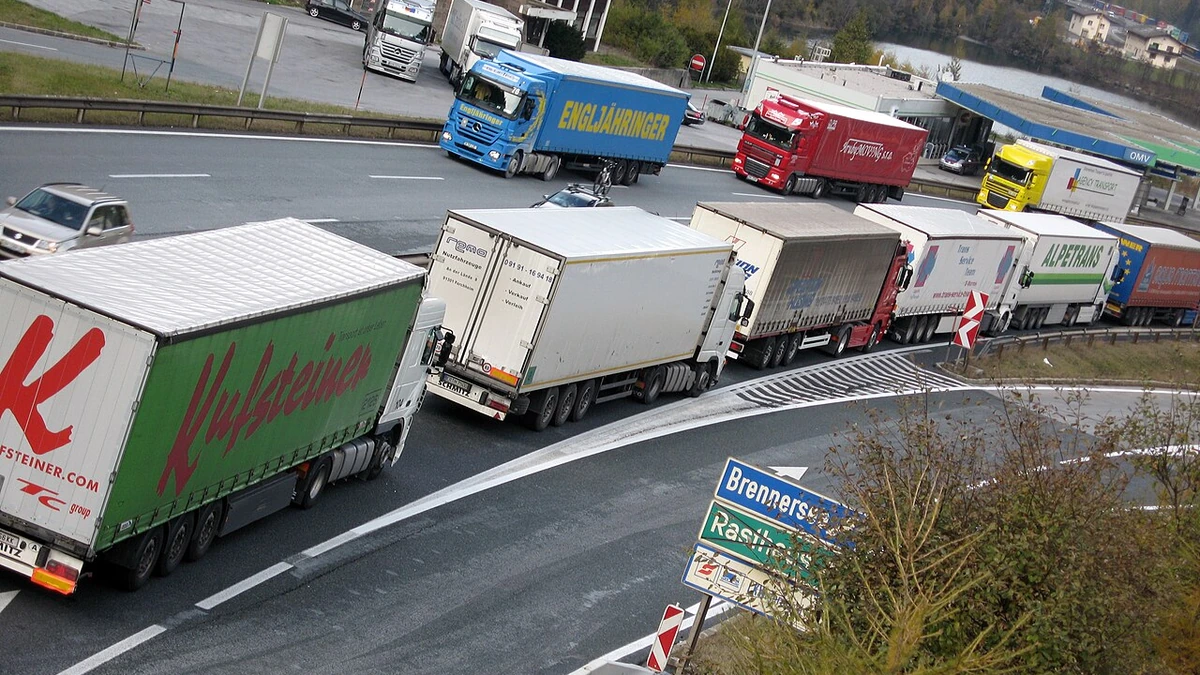
The volume of goods moved by road in Austria slipped to its lowest level since 2016 last year, extending a decline that has now run for four consecutive years. Trucks carried 549.4 million metric tonnes of freight on Austrian roads in 2025, down 0.6% from the previous year, Statistics Austria said Monday.
The fall was concentrated in shipments that began and ended within Austria. International freight arriving in or leaving the country increased, and foreign-registered trucks handled more cargo overall. That divergence makes the figures a more nuanced reading of freight activity than the nine-year low alone would suggest.
Measured by both cargo weight and the distance it traveled, however, road transport contracted. The total came to 52.9 billion tonne-kilometres on Austrian territory, a 0.9% annual decline. Those figures were published on October 12, 2026, but describe freight movements during 2025 rather than current conditions. The details appear in Statistics Austria’s annual road-freight report.
Domestic shipments drove the decline
Freight carried entirely within Austria fell 2.5% to 340.5 million tonnes, the largest percentage decline among the main traffic categories reported by the agency. Domestic movements still accounted for roughly 62% of the country’s total road-freight tonnage, so a reduction in that segment had a considerable influence on the overall number.
By contrast, cross-border shipments entering Austria rose 4.3% to 68.2 million tonnes, while those leaving Austria increased 4.2% to 64.3 million tonnes. Freight merely passing through the country was largely steady at 76.4 million tonnes, up 0.1%. The figures do not point to a uniform drop in all traffic using Austrian roads.
The distinction is also visible when freight is separated by the country where the truck is registered. Austrian-registered goods vehicles carried 352.6 million tonnes, down 9.7 million tonnes, or 2.7%, from 2024. Vehicles registered abroad moved 196.8 million tonnes, an increase of 6.3 million tonnes, or 3.3%. The gain for foreign vehicles was not enough to offset the fall in cargo hauled by Austrian-registered trucks.
Domestic routes are especially closely tied to locally registered fleets. Austrian vehicles handled 331.6 million tonnes of freight moved entirely within the country, representing 97.4% of that segment. A reduction in domestic traffic therefore had a much greater effect on Austria-registered carriers than on foreign vehicles operating longer international routes.
Among trucks registered outside Austria, vehicles from Poland transported 35.7 million tonnes, followed by Hungary at 26.9 million tonnes and Germany at 25.1 million tonnes. Together they accounted for 87.7 million tonnes, or 44.5% of the goods moved by foreign-registered trucks. These figures identify where the vehicles were registered, not necessarily where the cargo was produced, purchased or destined.
Long-distance traffic tells a different story
Cargo tonnage records how much weight is transported. Tonne-kilometres also account for the distance traveled, with one tonne moving one kilometre equal to one tonne-kilometre. Austria’s distance-based measure covers only the parts of journeys taking place inside its borders. That helps explain why the national and foreign fleets occupy very different positions in the two sets of figures.
Austrian-registered vehicles moved 64.2% of all road-freight tonnes but generated only 35.1% of tonne-kilometres on Austrian territory, equivalent to 18.6 billion. Foreign-registered vehicles carried the remaining 35.8% of the weight yet accounted for 64.9% of the distance-weighted measure, or 34.4 billion tonne-kilometres. Foreign vehicles were therefore associated with substantially longer freight movements within Austria, on average.
Transit freight illustrates the gap most clearly. Although goods passing through Austria represented only about 14% of total tonnage, transit accounted for 18.4 billion tonne-kilometres, roughly 35% of national road-freight performance. Its distance-weighted activity rose 1.6% in 2025 even though the amount of freight carried barely changed. Foreign-registered vehicles performed 99.2% of that transit activity.
Freight on routes wholly within Austria generated 17.8 billion tonne-kilometres, a 0.9% decline. Inbound international shipments accounted for 8.5 billion, down 0.8%, and outbound shipments produced 8.3 billion, down 5.9%. Thus the higher tonnage in both cross-border categories did not produce higher freight performance measured by distance traveled inside Austria. The report does not identify a single cause for that difference.
The main foreign contributors also change slightly depending on which measure is used. Trucks registered in Poland generated 8.0 billion tonne-kilometres in Austria, followed by Hungary at 4.3 billion and Slovenia at 3.7 billion. Their collective 16.0 billion tonne-kilometres represented 46.4% of the foreign-registered total. Germany ranked among the largest by weight carried, but Slovenia entered the leading three when distance was included.
Revisions and rail figures add context
The 0.6% annual decrease should be read against Statistics Austria’s revised comparison series. An earlier publication had placed total road-freight tonnage for 2024 at 562.6 million tonnes. The statistical office says it updates figures for earlier years when it releases new annual results, so calculating a 2025 decline directly from that older published total would not reproduce the latest official percentage. The new report’s year-over-year comparison is the appropriate one for the current data vintage.
There is another scope distinction. The report covers freight moved on Austrian roads by both domestic and foreign vehicles, not just the business of Austrian trucking firms. Statistics Austria uses its national freight survey for Austria-registered vehicles and European freight statistics for many foreign-registered vehicles. It also draws on cross-Alpine freight information for certain other countries and uses ASFINAG motorway toll data to weight foreign-vehicle estimates. The resulting totals are statistical estimates assembled from several datasets, not a direct census of every consignment.
A separate set of official figures shows that freight carried on Austria’s rail network moved in the opposite direction during 2025. Rail transport rose 1.8% to 96.2 million tonnes, and domestic rail tonne-kilometres increased 2.6% to 21.5 billion. The contrast is relevant to the transport sector, but it does not establish that particular loads shifted from road to rail. The two datasets track activity by mode, rather than following individual shipments across modes.
Nor does a reduction in tonnes hauled by road automatically show an equivalent fall in the value of goods traded, logistics revenue or industrial production. The road series measures physical goods transport and distance, not shipment prices or the value of freight. And because its latest full-year figures refer to 2025, they cannot by themselves establish whether traffic has since recovered or weakened further in 2026.
More News

Latest News
View all news- Gold Futures Retreat Toward $4,190 as U.S. Dollar Strengthens
- IonQ Agrees to Buy Cybersecurity Firm Elisity for Up to $1.3 Billion
- KKR, TotalEnergies to Add $1.2 Billion Solar Portfolio to U.S. Venture
- U.S. 30-Year Mortgage Rates Hover Near 7.55% as Housing Borrowing Costs Remain Elevated
- Wall Street Volatility Gauge Rises as Traders Assess Inflation and Earnings Risks
