
UK Government Announces More Than £1 Billion in Deals Linked to India Trade Mission
A 15-year aviation services license accounts for much of the value, alongside technology investment and multiyear export opportunities.
Our editorial standards
MarketReview publishes clear, independently produced financial information using reliable sources and transparent editorial standards.
Read our Editorial Policy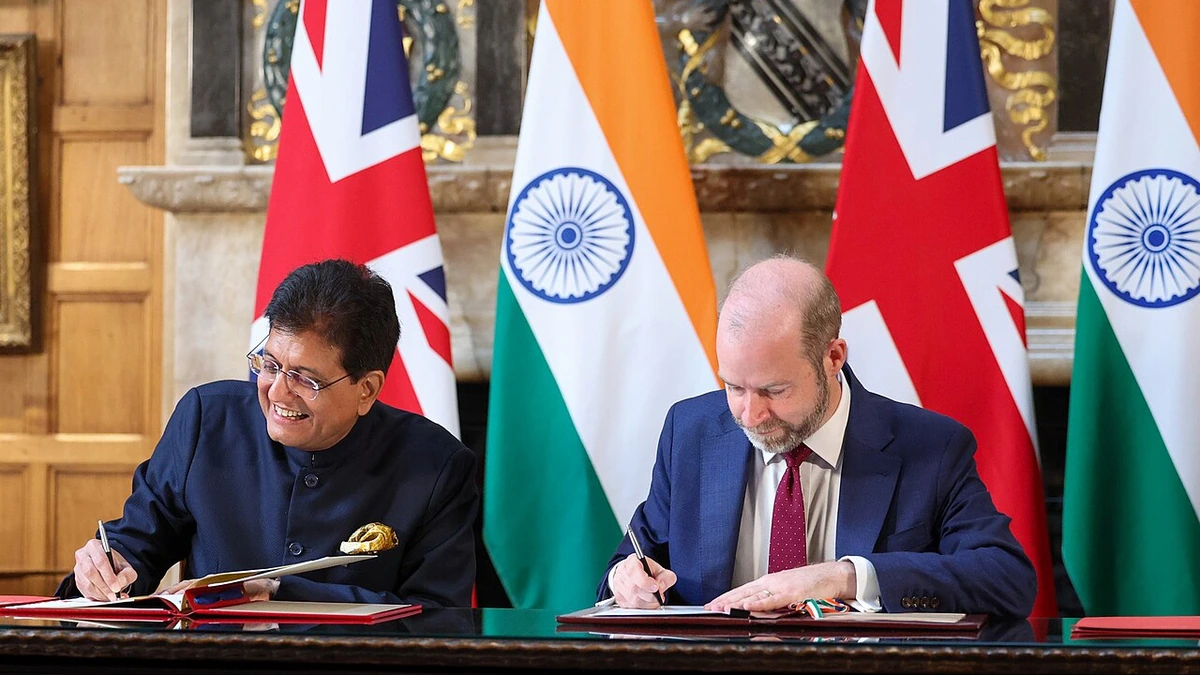
The UK government announced more than £1 billion in commercial deals linked to an India trade mission on Monday, with a long-term aviation services license accounting for much of the headline total. Ministers, northern English regional leaders and more than 100 businesses are travelling to India as Britain seeks to turn its recently implemented trade agreement into contracts, investment and jobs.
The announcement covers several different kinds of business activity. Some firms have secured work, others expect revenue over periods stretching years into the future, and some have outlined investment plans. The government’s billion-pound figure is therefore not a measure of cash immediately invested in Britain or export sales already completed.
The visit to Delhi and Mumbai comes less than three months after the UK-India free trade agreement entered into force on July 15. British officials are presenting the latest commercial announcements as evidence of growing interest in the market, with particular emphasis on businesses and regional economies outside London.
Menzies Aviation leads a varied package of commercial wins
The biggest item in the government’s published breakdown is Menzies Aviation’s ground-handling license in Bengaluru. The UK aviation services provider is expected to generate more than £600 million in revenue from the 15-year license, backed by a £6 million investment. The agreement covers services at what the government describes as India’s largest domestic cargo facility, and the company expects its expanding Indian operations to support more than 1,000 jobs.
That revenue figure stretches across a decade and a half; it is not £600 million in immediate export receipts. The distinction matters because it is the largest single component of a package that also includes forward-looking estimates and proposed investments. Nor should employment tied to aviation operations in India be confused with the separate UK jobs attached to other announcements.
Telecommunications technology adds another potentially large export opportunity. RANsemi has signed a strategic partnership intended to expand the reach of British-developed 5G Open RAN semiconductor technology in India, with the government putting the opportunity at more than £100 million over five years. Engineering consultancy Buro Happold expects to generate £90 million in revenue from Indian projects over three years and plans to invest £3 million in the country as it expands its operations.
On the inward-investment side, Meta for Data Technologies plans to put £50 million into the UK and create 500 skilled jobs in London and Manchester. The proposed work includes facilities for artificial intelligence and data research, engineering and quantum computing. That planned UK investment has a different economic effect from a British company’s projected revenue in India, even though both sit within the same announced total.
Retail and professional services also feature. Children’s clothing brand Angel & Rocket plans to open 100 stores in India over five years, an expansion the government says could generate about £43 million in revenue. It is backed by investment of up to £5 million. Gleeds, a construction consultancy, reported £27 million in Indian contracts, while healthcare technology company Panakeia is pursuing expansion expected to generate more than £27 million in export value. The varying commitments show why the headline figure needs to be read as a collection of commercial wins and projections rather than a single, fully realized contract value.
Northern business leaders are central to the India mission
The delegation includes northern mayors, a combined authority leader, Business Secretary Jonathan Reynolds and the UK ministers responsible for the environment and Scotland. More than 100 participating businesses represent areas ranging from advanced technology to food and drink. The political aim is to develop trade opportunities for regional companies that may have fewer established channels into India than large multinationals.
For British exporters, the visit is also a chance to put the trade agreement’s tariff changes to use. According to the government, Indian tariffs on Scotch whisky have already fallen from 150% to 75%, while salmon can now enter India duty-free. Representatives from the Scotch whisky, salmon and broader food industries are among those travelling with ministers. Lower tariffs can make products more competitive, but they do not by themselves guarantee new buyers or a particular volume of exports.
The mission’s agenda extends beyond the announced commercial values. Oxford Nanopore is due to sign a memorandum of understanding with India’s Biotechnology Research and Innovation Council-Centre for DNA Fingerprinting and Diagnostics for a centre of excellence in Hyderabad. A memorandum of understanding is a proposed framework for cooperation, rather than evidence that a stated amount of sales has already been earned.
Reynolds is also scheduled to meet Indian Commerce Minister Piyush Goyal to co-chair the UK-India Joint Economic and Trade Committee. Separate science discussions with Indian Minister Jitendra Singh are planned. These meetings are part of the attempt to build institutional relationships that businesses can use after the delegation has returned home.
A new trade agreement provides the backdrop, not the final results
Britain and India signed their Comprehensive Economic and Trade Agreement on July 24, 2025. It took effect on July 15, 2026, opening the way for tariff reductions and other market-access measures. The government says deals worth nearly £12 billion have been struck since the agreement was signed, including the latest announcements. That cumulative figure is an official account of commercial activity, not a statement that the full amount has already flowed through trade or investment accounts.
The wider relationship was already substantial before the agreement became operative. The government’s release puts total UK-India trade at £48 billion in the 12 months to March 2026, up £3 billion from the preceding year in current prices. Because that measurement period ended before the July implementation date, the increase cannot be presented as a realized effect of the new tariff regime.
Officials expect the free trade agreement to lift bilateral trade by £25.5 billion a year in the long run, but that is a projection about future activity, not an additional £25.5 billion already recorded. It is important to keep that estimate separate from the £1 billion-plus collection of company deals announced with this mission and from the historical £48 billion trade figure. Each number answers a different question.
The most concrete tests will unfold on different schedules. Meta for Data Technologies would need to carry through its UK investment and hiring plans, retailers must open the stores they have proposed, and exporters will have to turn expected demand into sales. The longest revenue horizon disclosed in the current package belongs to Menzies Aviation, whose £600 million-plus estimate covers 15 years of services in Bengaluru. Over the nearer term, ministers’ scheduled meetings and business introductions in India may establish which prospective relationships progress into signed work.
More News

Latest News
View all news- Gold Futures Retreat Toward $4,190 as U.S. Dollar Strengthens
- IonQ Agrees to Buy Cybersecurity Firm Elisity for Up to $1.3 Billion
- KKR, TotalEnergies to Add $1.2 Billion Solar Portfolio to U.S. Venture
- U.S. 30-Year Mortgage Rates Hover Near 7.55% as Housing Borrowing Costs Remain Elevated
- Wall Street Volatility Gauge Rises as Traders Assess Inflation and Earnings Risks
