Japanese Investors Outline $1.2 Billion Tourism Investment Plan in Bangladesh
A Japanese delegation outlined a $1.2 billion tourism plan in Dhaka, but formal proposals, project locations and financing terms have yet to be disclosed.
Our editorial standards
MarketReview publishes clear, independently produced financial information using reliable sources and transparent editorial standards.
Read our Editorial Policy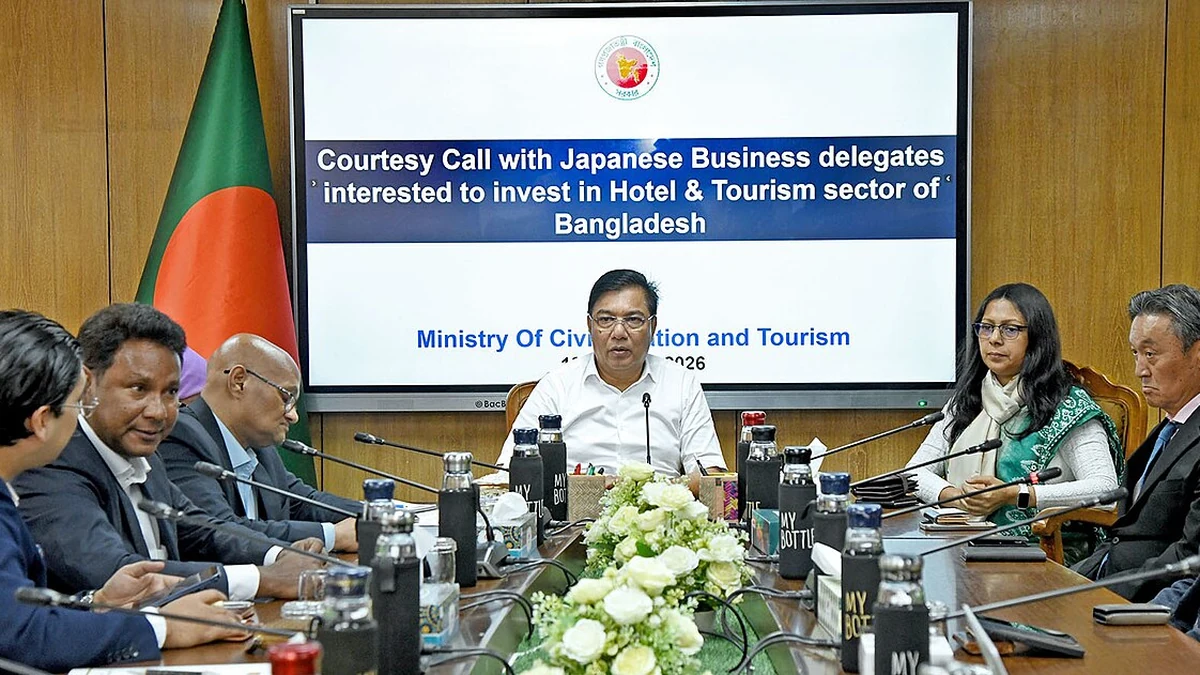
Japanese investors have outlined plans to invest an initial $1.2 billion in Bangladesh’s tourism and hospitality industry, according to the country’s Ministry of Civil Aviation and Tourism. The announcement came during a meeting in Dhaka on Sunday, October 18, but the government is still awaiting formal investment proposals before taking the next administrative steps.
The delegation met Civil Aviation and Tourism Minister M. Rashiduzzaman Millat at the Bangladesh Secretariat. The investors expressed interest in working with Bangladeshi partners to develop tourism and hospitality facilities, according to accounts of the ministry’s statement. The figure sets out an intended scale of investment rather than money already spent on projects.
Millat welcomed the interest and offered government cooperation, particularly through public-private partnerships. He also asked the Bangladesh Tourism Board to facilitate visits to prospective tourism destinations so the visitors could examine opportunities on the ground. Neither the meeting account nor the accompanying announcement described a signed development agreement.
The $1.2 Billion Proposal Is Still at an Early Stage
The minister said the government would move promptly on the necessary legal and administrative procedures once the Japanese investors submitted formal proposals. That sequence matters: the announcement establishes interest, but it does not yet identify a financed portfolio of resorts, hotels or other tourist facilities. A submission would give authorities a basis to evaluate individual projects rather than a single headline amount.
Public accounts of the discussion did not name the companies in the Japanese delegation or assign investment amounts to particular locations. They also did not provide a construction schedule, describe financing arrangements or say whether specific assets would be owned by private investors or developed jointly with public agencies. Without those details, the proposed $1.2 billion cannot be treated as a confirmed inflow of foreign direct investment.
The reference to an initial investment leaves open the possibility of further activity, but the statement did not set out additional phases or a larger overall target. Nor did it give a deadline for converting the announced intention into signed commitments. The next evidence of progress would be documented project proposals, followed by decisions on their scope and approval requirements.
Site visits may help determine where potential developments could be located and what infrastructure they would need. The Tourism Board’s planned involvement is therefore more than a courtesy arrangement, although it remains an exploratory step. Visits to a destination would not themselves constitute project selection, land allocation or approval to begin building.
Tourism Plans Already Put Private Capital in Focus
Bangladesh has been seeking more private investment in its visitor economy. In remarks published by the tourism ministry in September, Millat said the government was preparing a tourism master plan covering roughly 1,498 attractions and destinations. The same statement described a policy emphasis on private investment and public-private partnerships, with Cox’s Bazar singled out for potential expansion of tourism infrastructure and services.
At that September event, the minister also set out an ambition to lift tourism’s contribution to gross domestic product to 8% to 9%. That was a government objective, not a reported measure of the sector’s current share. The Japanese proposal offers a possible source of capital for the wider agenda, but no official announcement has established that it will fund the master plan or meet any specified part of the target.
The destinations Millat highlighted during Sunday’s meeting included Cox’s Bazar and its long coastline, the Sundarbans mangrove forest and Sylhet’s tea-growing areas. Each offers a different kind of visitor experience and would raise different development questions. The minister presented them as examples of Bangladesh’s tourism potential, not as an approved list of sites for Japanese-backed construction.
Tourism projects also appear in Bangladesh’s existing public-private partnership pipeline. The Public Private Partnership Authority’s official project register, updated in August, lists international-standard tourism facilities at the Hotel Shaibal compound in Cox’s Bazar and a proposed cable car from Himchhori to Reju Khal. Both were shown at the adviser-appointment stage, illustrating that identifying a tourism project and securing private financing are separate parts of development.
Those registered proposals predate the October meeting, and there is no verified link between them and the visiting investors. Their relevance is institutional: the government already has a process for assessing tourism developments under the partnership model that Millat raised with the Japanese delegation. It would be premature to imply that the new $1.2 billion figure has been earmarked for any project currently on that list.
Site Assessments and Formal Filings Come Next
The government’s immediate undertaking is to arrange for the investors to see prospective tourism areas and to consider the proposals when submitted. The ministry did not announce dates for those visits or for the filing of investment documents. It also gave no indication of when capital might be deployed, how many properties could be developed or how many jobs the proposals could create.
If projects ultimately proceed through public-private partnerships, the financial terms will matter as much as the announced investment total. A project’s structure would determine which party provides land and supporting infrastructure, how construction is financed, who bears operating risk and what rights the private partner receives. No such allocations were disclosed at the meeting, so they remain questions for later negotiations rather than features of an agreed package.
Millat described Japan as a longstanding development partner and pointed to its role in Bangladesh’s infrastructure. The Japanese representatives, for their part, said they were willing to work jointly on tourism development. Those expressions of support explain why talks are taking place, but they do not identify the backers or lenders of any future investment vehicle.
For now, the clearest milestones are the Tourism Board’s proposed site visits and the investors’ formal submissions. Until proposals specify the projects, participants and funding arrangements, the $1.2 billion remains a stated investment plan rather than a completed commitment to Bangladesh’s tourism sector.
More News
Latest News
View all news- UK Announces Nearly £140 Million for 14 Urgent-Care Projects Ahead of Winter
- Israel Revises Second-Quarter GDP Growth Up to 15.4% in New October Estimate
- French Retailers Estimate Hundreds of Millions of Euros in Damage After Nationwide Protests
- Australian Government Commits A$6 Million to Western Australia’s Telethon
- Anthropic Co-Founder Cites Scenario of $44 Trillion U.S. GDP by 2030 as AI Advances