Singapore’s Lee Urges Australia to Invest More in Southeast Asia
Lee Hsien Loong pointed to Australia's small investment position in ASEAN compared with its trade ties, as Canberra works to expand regional business links.
Our editorial standards
MarketReview publishes clear, independently produced financial information using reliable sources and transparent editorial standards.
Read our Editorial Policy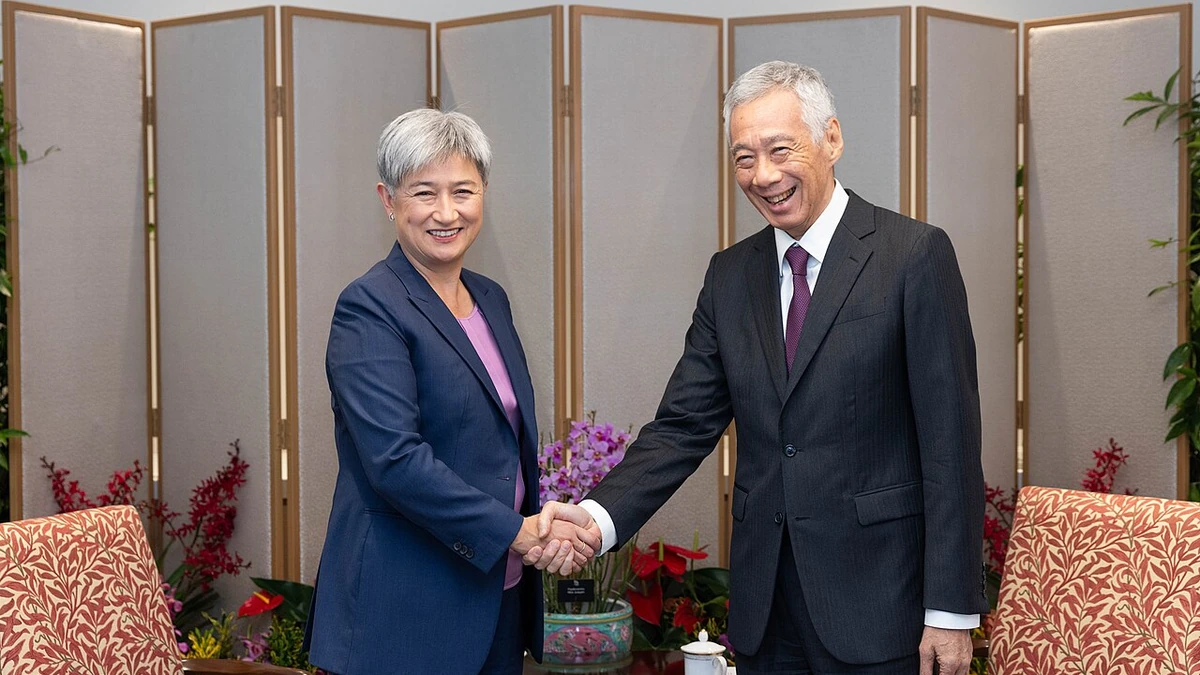
Singapore Senior Minister Lee Hsien Loong has urged Australia to invest more in Southeast Asia, arguing that its business presence in the region is smaller than the scale of its trade would suggest. In a lecture released November 8, he said deeper commercial ties could strengthen Australian supply chains and give the country more options in a changing global economy.
The appeal came in a Boyer Lecture titled Engaging Asia from Down Under. Lee’s economic argument was not that Australia lacked access to Asian markets. Rather, he said its investment footprint had not kept pace with its trading relationship with countries in the Association of Southeast Asian Nations (ASEAN).
In the speech transcript published by Singapore’s Prime Minister’s Office, Lee described Southeast Asia as Australia’s second-largest trading partner after China. He contrasted the country’s investment across ASEAN with what it holds in neighboring New Zealand, and called for Australian businesses to build a larger presence in Southeast Asian markets.
Australia’s ASEAN investment gap is visible in the data
Official figures give that comparison a sharper edge. At the end of 2025, Australia’s investment position in ASEAN was A$103.6 billion, compared with A$221.6 billion in New Zealand, according to the Australian Bureau of Statistics. The ASEAN figure was down from A$105.7 billion a year earlier, while investment holdings in New Zealand rose from A$205.2 billion.
These are year-end investment stocks, not the amount of new money invested during 2025. The measures capture the value of accumulated investment positions and include more than ownership of operating businesses. They cannot, by themselves, establish how many new factories, infrastructure projects or local partnerships Australian companies financed during the year.
The geographic pattern also matters. Australia’s holdings in Singapore alone were valued at A$77.2 billion at the end of 2025, accounting for much of the ASEAN total. Because Singapore is a regional financial and corporate hub, investment recorded there may support activity elsewhere. Still, the figures show how unevenly Australian capital is distributed across the region.
Lee’s comparison was particularly pointed because Australia’s export relationships are already extensive. The country sells minerals, agricultural products and services into Asian markets, including education and tourism. Establishing a lasting investment presence can be harder than exporting: businesses need local expertise, reliable commercial partners and confidence that a project’s returns justify its risks.
Australia’s own Southeast Asia economic strategy acknowledges those obstacles. Its assessment of the region cites concerns about risk and return, governance standards and the information investors need before committing capital. Those barriers help explain why a growing trade relationship does not automatically translate into equivalent long-term investment holdings.
Critical minerals, clean energy and technology offer potential openings
Lee identified critical minerals, agribusiness, renewable energy and advanced technology as areas where Australian companies could expand their role. He pointed to businesses across Southeast Asia that could supply Australian projects or buy their output. The opportunity, as he described it, is to develop closer commercial links along supply chains rather than rely entirely on shipments of finished products or raw materials.
The possibilities vary by industry. Renewable-energy projects may require generation equipment, grid infrastructure and specialist services. Mineral developments can depend on processing capacity and customers in several markets. Technology companies may need regional partners to reach businesses and users. None of those examples amounts to a specific investment commitment: Lee’s lecture set out a commercial case for deeper engagement, not a list of newly approved projects.
Canberra already has a policy framework for pursuing that goal. Australia’s Southeast Asia Economic Strategy to 2040, launched in 2023, is intended to increase trade and investment in both directions. The Department of Foreign Affairs and Trade describes investment teams, business missions, support for preparing projects and technology-focused programs among the measures being implemented.
One of the government’s principal financing tools is the A$2 billion Southeast Asia Investment Financing Facility. It is designed to provide loans, guarantees, equity and insurance for projects that support Australian trade and investment in the region, particularly clean energy and infrastructure. The A$2 billion refers to the announced size of the facility, not money that has necessarily already been invested in projects.
More available financing does not remove the need for commercial due diligence. Australian businesses still have to judge country-specific regulations, local demand, project costs and potential partners. That distinction is important in a region whose economies have very different industrial bases and investment conditions. Greater access to finance may help projects proceed, but it does not assure their profitability.
Lee ties economic links to regional resilience
Lee placed the investment call within a broader argument about an increasingly contested Asia-Pacific. He said rivalry between major powers and a more difficult trading environment had pushed governments to pay closer attention to economic security. In that setting, dependable partnerships could give countries more room to pursue their interests without treating every commercial decision as a choice between Washington and Beijing.
His message was not that Australia should distance itself from the United States. Lee said countries across the region still wanted American engagement, while recognizing a greater need for self-reliance. He urged Australia to maintain its defense presence and working relationships in Asia, including with countries whose strategic interests differ from its own.
Australia’s history of helping establish regional institutions also featured in the lecture. Lee cited its part in forming the Asia-Pacific Economic Cooperation forum and advancing the Comprehensive and Progressive Agreement for Trans-Pacific Partnership. He argued that such efforts can preserve channels for practical cooperation even when agreement among the largest powers is difficult.
Trade rules were part of that argument. Lee called for continued support for the World Trade Organization and fuller use of existing agreements, pointing to work by Singapore, Australia and Japan on electronic-commerce rules. For companies considering long-term investments, stable trade arrangements and predictable cross-border relationships can matter alongside expected demand.
Singapore and Australia have also been working on a more specific supply-chain measure. On July 27, the countries signed a protocol on economic resilience and essential supplies under their bilateral free-trade agreement. Australia’s Department of Foreign Affairs and Trade said it is intended to support trade in critical supplies during disruptions and establish a bilateral dialogue on economic resilience. The protocol will enter into force once both countries complete their domestic procedures.
More News


Latest News
View all news- Sensex, Nifty End Lower in Diwali Muhurat Trading, Breaking Eight-Year Winning Streak
- Bank of Israel Finds 62% of Survey Respondents Faced Financial Fraud Attempts
- New Zealand’s Revised Parliamentary Funding and Expense Rules Take Effect
- U.S. Emergency Power Orders for Puerto Rico Take Effect, Extending Grid Support Into February
- Berkshire Hathaway Reports Lower Q3 Operating Earnings, $9.6 Billion in Share Buybacks