U.S. Finalizes Colorado River Cuts as $1.4 Trillion Western Economy Faces Water Strain
Federal rules for 2027 and 2028 cut Lower Basin Colorado River deliveries by 1.25 million acre-feet a year as record-low reservoirs sharpen economic risks across the West.
Our editorial standards
MarketReview publishes clear, independently produced financial information using reliable sources and transparent editorial standards.
Read our Editorial Policy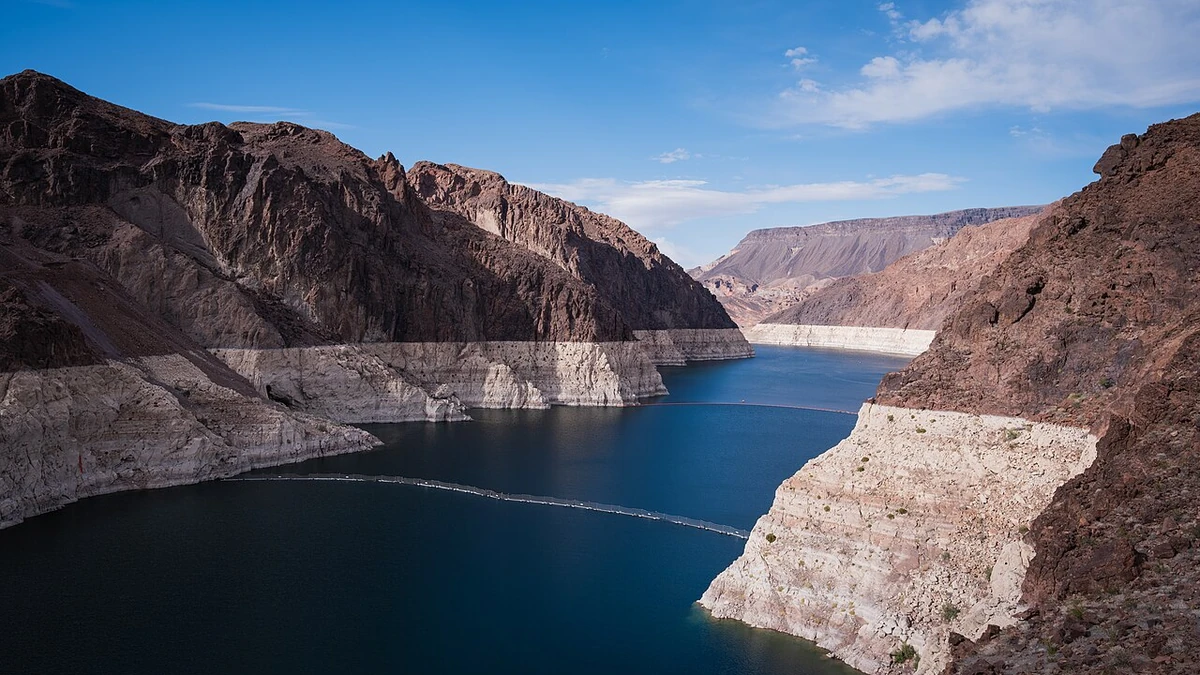
Colorado River water scarcity is moving from a long-running environmental problem into a more immediate economic constraint for the U.S. West after the Interior Department finalized new operating rules requiring substantial reductions in Lower Basin deliveries for 2027 and 2028. Lake Powell and Lake Mead have also fallen to record lows, forcing federal officials to protect water supplies, hydropower infrastructure and reservoir operations across a system relied on by tens of millions of people.
A widely cited $1.4 trillion figure attached to the river shows the scale of that dependence, but it needs careful interpretation. That number is not a forecast that the newly announced reductions will erase $1.4 trillion of output. It comes from an older economic model that asked what would happen if Colorado River water were unavailable for a full year with no substitute supply, a far more severe scenario than the new federal plan.
Federal rules lock in two years of Lower Basin reductions
On August 21, the Interior Department issued operating guidelines for 2027 and 2028 along with a Record of Decision for the post-2026 Colorado River framework. Under the rules, Lower Basin water deliveries will be reduced by 1.25 million acre-feet in each of the next two years. If the Lower Basin states implement their proposed sharing agreement, Arizona would account for 760,000 acre-feet of the annual reduction, California for 440,000 acre-feet and Nevada for 50,000 acre-feet.
Lower Basin states are also expected to voluntarily conserve and store at least 700,000 acre-feet over the two-year period, on top of the annual reductions. For Lake Powell, the new rules use hydrology and a minimum elevation of 3,510 feet as key operating criteria intended to support reliability at Glen Canyon Dam. Reclamation expects the reservoir to begin the October 1 water year between elevations of 3,540 and 3,510 feet, with an expected water-year release of 6 million to 7 million acre-feet before the final 2027 volume is determined in April.
Those operating choices reflect a basin with little room left for normal assumptions. According to Interior, the combined contents of Lake Powell and Lake Mead are lower than at any time since before Lake Powell began filling after Glen Canyon Dam was closed in 1963, and both reservoirs have hit record lows in recent weeks. Conditions deteriorated further during 2026 after the winter of 2025-2026 produced the lowest observed snowpack on record.
A two-year operating plan does not settle the longer dispute over how the seven basin states should divide a shrinking and highly variable supply. Instead, it sits inside a 10-year federal decision framework through 2036. Future operating rules can be issued in two-year periods, with room to incorporate a broader state or tribal consensus if one is reached.
What the $1.4 trillion figure actually measures
Drought.gov’s Colorado River Basin page continues to cite an estimate that the river supports about $1.4 trillion in annual economic activity and 16 million jobs across Arizona, California, Colorado, Nevada, New Mexico, Utah and Wyoming. The underlying estimate comes from a 2014 study by Arizona State University’s L. William Seidman Research Institute, which examined the economic importance of Colorado River water using modified IMPLAN input-output models.
Using a 2012 economic base, the researchers made two deliberately severe assumptions: Colorado River water would be unavailable for one full year, and no other water source could replace it during that year. Under that scenario, the model estimated about $1.434 trillion in lost gross state product, 16 million job-years and $871.45 billion in labor income in 2014 dollars across six basin states and seven Southern California counties. Researchers explicitly described complete non-availability for a year as unlikely, using it as a way to estimate the river’s overall economic importance.
For a current news story, that methodology makes the $1.4 trillion number a broad measure of economic dependence rather than a projection of losses from the 2027 and 2028 cuts. Federal reductions are not uniform across the basin, and the operating plan includes conservation, reservoir storage and other management tools. ASU also cautioned that simple linear extrapolation becomes problematic when water losses differ across geographies because trade and supply-chain effects can become non-linear.
Beyond agriculture, the model placed some of its largest private-sector gross state product exposure in real estate and rental activity, health care and social services, finance and insurance, professional and technical services, and retail trade. These estimates are dated and should not be treated as present-day sector forecasts. They do, however, illustrate why severe water constraints can spread through housing, services and business activity rather than remaining confined to farms and utilities.
Arizona carries the largest near-term reduction
Under the proposed Lower Basin sharing plan, Arizona carries the largest nominal cut. Its 760,000 acre-foot annual reduction exceeds California’s 440,000 acre-feet and Nevada’s 50,000 acre-feet even though California has the largest Lower Basin allocation. The split comes from the Lower Basin states’ proposed sharing agreement rather than a simple division based on population or state economic size.
Near-term reductions also sit well inside the broader operating range approved for later years. In the Final Environmental Impact Statement released in July, Interior said the 10-year framework allows Lower Basin shortages of up to 3 million acre-feet, Lake Powell annual releases between 5 million and 12 million acre-feet, and voluntary Upper Basin conservation of up to 200,000 acre-feet, depending on hydrology. Those figures are operating sideboards, not scheduled future cuts. They show how much discretion federal officials preserved if reservoir conditions improve or deteriorate after 2028.
Interior says the Colorado River supports more than 40 million people, 30 tribes and 5.5 million acres of farmland while also generating hydropower for seven states. Such breadth helps explain why increasingly tight river operations matter to economic planning as well as natural-resource policy. Even when shortages do not translate into immediate urban cutoffs, they can change the cost and timing of conservation, storage, infrastructure investment and agricultural water use.
Near-term federal timing is now clearer than the long-term settlement. The new guidelines govern the start of the 2027 water year on October 1, and Reclamation expects to determine the final Lake Powell release volume for water year 2027 in April. Later operating periods can still be revised if the basin states, tribes and federal government reach broader agreements within the 10-year framework.
More News

Latest News
View all news- Gold Futures Retreat Toward $4,190 as U.S. Dollar Strengthens
- IonQ Agrees to Buy Cybersecurity Firm Elisity for Up to $1.3 Billion
- KKR, TotalEnergies to Add $1.2 Billion Solar Portfolio to U.S. Venture
- U.S. 30-Year Mortgage Rates Hover Near 7.55% as Housing Borrowing Costs Remain Elevated
- Wall Street Trades Mixed as Oil Prices Rise Ahead of Major Bank Earnings