Germany Raises Q2 GDP Growth Estimate to 0.3% as Exports Strengthen
Germany’s economy expanded 0.3% in the second quarter, one-tenth of a percentage point more than first estimated, as stronger goods exports offset weak investment and subdued consumption.
Our editorial standards
MarketReview publishes clear, independently produced financial information using reliable sources and transparent editorial standards.
Read our Editorial Policy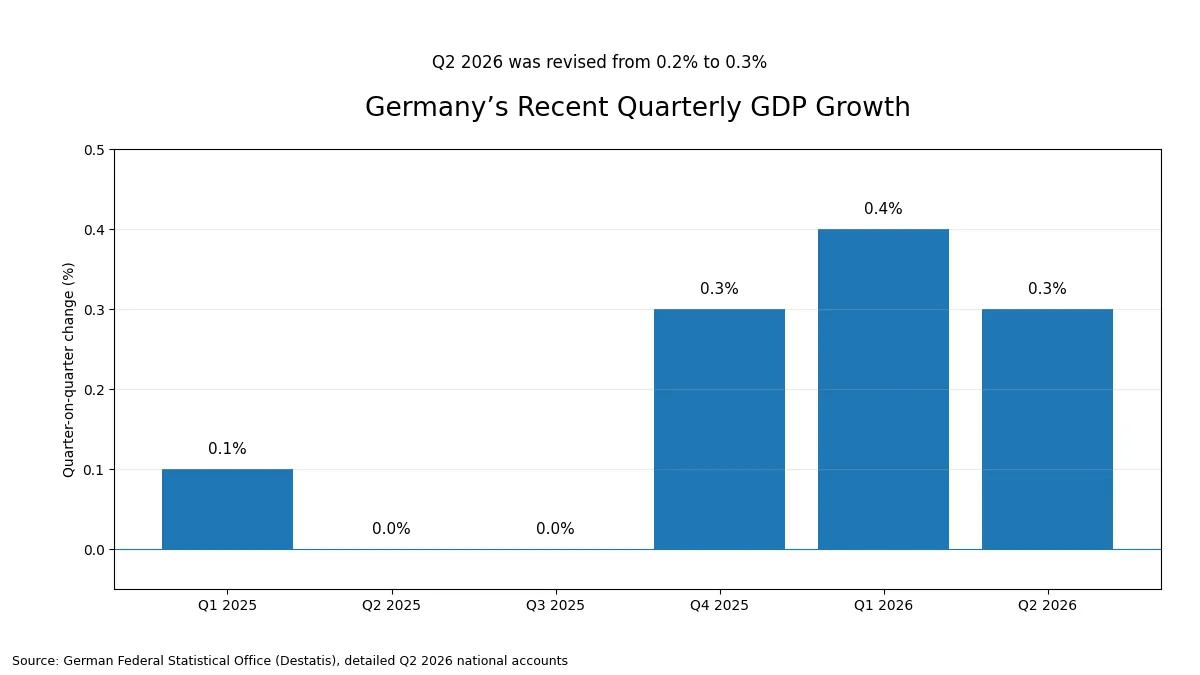
Germany’s economy grew 0.3% in the second quarter from the first three months of 2026, stronger than the 0.2% expansion reported in the government’s preliminary estimate. The revised, price-adjusted figure was also seasonally and calendar adjusted and followed growth of 0.4% in the first quarter.
Output was 1.0% higher than a year earlier on both a price-adjusted basis and after price and calendar adjustment. The latest quarterly result extends a modest run of growth that began in late 2025, although the composition remained heavily dependent on foreign trade rather than broad strength in domestic demand.
In its detailed second-quarter national accounts release, the German Federal Statistical Office said newly available indicators produced a somewhat better picture than the first estimate. Wholesale and retail trade performed better than previously assumed, while June goods-trade data prompted a noticeable upward revision to exports.
Exports supply most of the second-quarter lift
Exports of goods and services increased 2.0% from the first quarter after price, seasonal and calendar adjustment. Goods shipments rose 2.6%, while services exports were unchanged. Imports also increased, but at a slower overall pace of 1.5%, including gains of 2.1% for goods and 0.3% for services.
That difference gave net exports a 0.2 percentage-point contribution to quarterly GDP growth, according to the expenditure breakdown. Domestic uses contributed 0.1 point, showing that foreign demand accounted for most of the 0.3% expansion even as imports also rose.
The annual comparison points in the same direction. Price-adjusted exports were 3.7% higher than in the second quarter of 2025, led by a 5.0% rise in goods exports. Destatis identified chemical products, data-processing equipment, electronic and optical products, and other transport equipment among the categories supporting the increase, with goods trade improving particularly with other European Union countries.
Services exports slipped 0.1% from a year earlier, and imports of goods and services increased 2.5%. Goods imports rose 4.2%, including stronger purchases from the United States, China and EU partners, while services imports declined 1.2%, partly because of lower transport-service imports.
Manufacturing improves as investment and hiring lag
Domestic spending remained restrained during the quarter. Gross fixed capital formation declined 0.2%, with machinery and equipment investment falling 1.4%. Construction investment edged up 0.1%, but the statistical office said stronger growth did not emerge after an unusually cold start to the year weighed on activity.
Household consumption and government consumption each increased only 0.1% from the first quarter. On a year-over-year basis, final consumption was up 1.0%, but the split was uneven: household spending grew 0.1%, compared with a 3.0% increase in government consumption.
Production data offered a firmer signal. Gross value added increased 0.4% from the previous quarter, with manufacturing up 0.9% as chemicals and electrical equipment improved. Information and communication, real estate, and public services, education and health each recorded growth of 0.6%, while financial and insurance activities fell 0.7% and construction slipped 0.1%.
Compared with a year earlier, manufacturing value added rose 1.1%, its first annual increase since the first quarter of 2023. Information and communication expanded 3.9% and public services, education and health grew 2.1%, while construction value added fell 1.6%.
The recovery in output has not yet translated into employment growth. About 45.7 million people were employed at workplaces in Germany in the second quarter, down 212,000, or 0.5%, from a year earlier. Service-sector employment declined for the first time since the Covid-19 crisis, while manufacturing and construction continued to record year-over-year employment declines.
With average hours worked per employee unchanged, total labor volume also fell 0.5%. Price-adjusted GDP per hour worked and per employed person each rose 1.5%, indicating that higher output was produced with fewer workers than a year earlier.
Summer revisions strengthen the recent growth record
The second-quarter upgrade came as Destatis completed its annual summer revision of the national accounts. Quarterly growth rates for recent years received changes ranging from a downward revision of 0.2 percentage point to an upward revision of 0.6 point as the agency incorporated newer and more complete information.
The largest annual change affected 2024. Germany had previously been reported to have contracted 0.5% that year, but the revised series now shows no change in economic output. Growth for 2025 remained at 0.2%, while the quarterly sequence now shows stagnation in the second and third quarters of 2025 followed by gains of 0.3% in the fourth quarter, 0.4% in the first quarter of 2026 and 0.3% in the second.
Destatis also revised annual data back to 2011 after incorporating key source information into the calculations. The agency said the annual growth rates for 2011 through 2021 were up to 0.1 percentage point higher than previously published, lifting cumulative growth over that period by 0.8 percentage point.
The revision illustrates why the more detailed GDP estimate can differ from the early reading. Germany’s first quarterly release is issued about 30 days after the period ends, when information is still limited. A fuller estimate follows roughly 25 days later with a more precise data basis, especially for the final month of the quarter, and later releases can change again as additional statistics arrive.
Even after the upgrade, Germany trailed the European Union’s 0.5% quarterly growth in the second quarter. Spain expanded 0.7%, while France and Italy each grew 0.2%; Germany’s 1.0% annual increase was also below the EU’s 1.2%. The revised domestic series nevertheless records three consecutive quarters of expansion after two flat quarters in 2025.
More News



Latest News
View all news- Gold Futures Retreat Toward $4,190 as U.S. Dollar Strengthens
- IonQ Agrees to Buy Cybersecurity Firm Elisity for Up to $1.3 Billion
- KKR, TotalEnergies to Add $1.2 Billion Solar Portfolio to U.S. Venture
- U.S. 30-Year Mortgage Rates Hover Near 7.55% as Housing Borrowing Costs Remain Elevated
- Wall Street Volatility Gauge Rises as Traders Assess Inflation and Earnings Risks