Norway’s Unemployment Rate Falls to 4.5% in July
Statistics Norway counted 138,000 unemployed people in July, while a revision lowered June’s trend rate to 4.5% and youth labor-market participation continued to rise.
Our editorial standards
MarketReview publishes clear, independently produced financial information using reliable sources and transparent editorial standards.
Read our Editorial Policy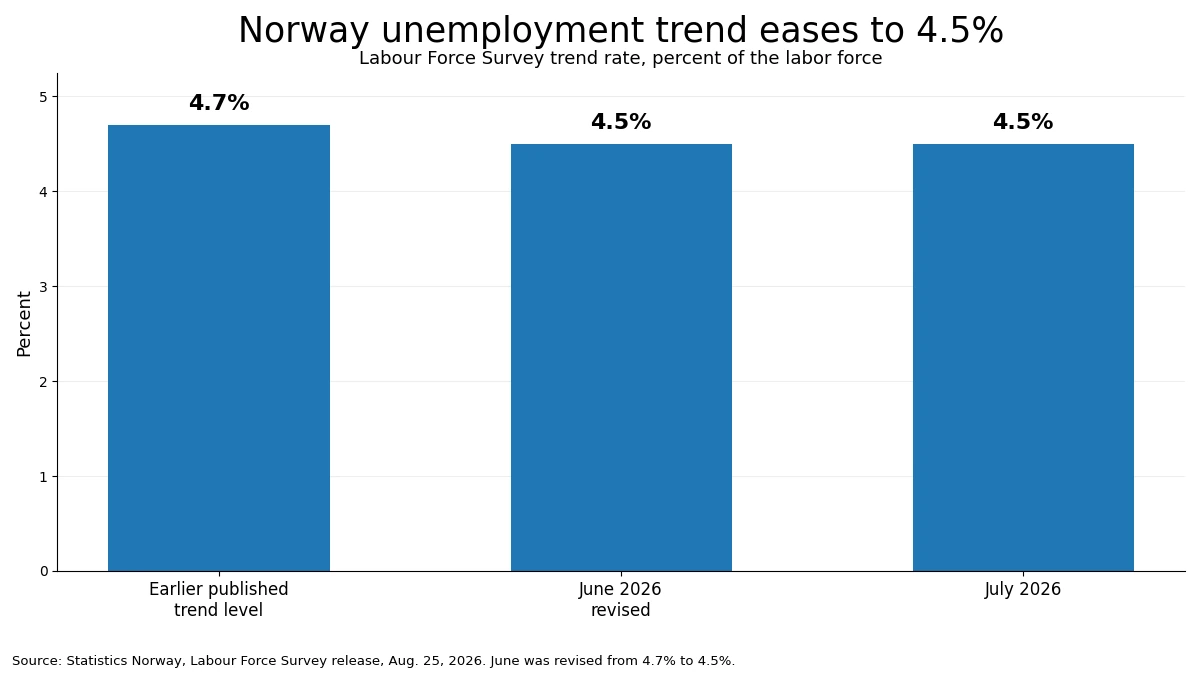
Norway’s unemployment rate was 4.5% in July, with 138,000 people classified as unemployed, according to the latest trend figures from Statistics Norway’s Labour Force Survey. The agency said the newest estimates show unemployment has eased after spending a period at 4.7%, with the latest reading also accompanied by a downward revision to the previous month.
June’s unemployment rate was revised to 4.5% from the 4.7% reported in the prior monthly publication. That means the latest data do not show a simple drop from an unrevised 4.7% in June to 4.5% in July. Instead, the new information caused Statistics Norway to recalculate the trend series, lowering the estimate for June as well as placing July at 4.5%.
The agency said in its August 25 labor-market update that previously published trend figures can change as another month of information becomes available. Tonje Køber, head of section at Statistics Norway, said the latest numbers show unemployment has come down to 4.5% after being around 4.7% for some time.
Youth labor-market indicators improve
The July release showed a stronger direction among people aged 15 to 24. Since the beginning of 2026, the labor-force participation rate for that age group has increased by 0.9 percentage point. Over the same period, youth unemployment has fallen by 0.6 percentage point and the employment rate has risen by 1.1 percentage points.
Statistics Norway said the pattern suggests more young people are managing to find work. The combination matters because a lower unemployment rate can sometimes reflect people leaving the labor force rather than finding jobs. In this case, however, the agency reported higher participation at the same time as a higher employment rate and lower unemployment among young people, giving the youth figures a broader base than the unemployment rate alone.
The national unemployment estimate comes from the Labour Force Survey, which is designed to measure employment, unemployment and labor-force participation across the population. Statistics Norway recommends using trend figures when assessing monthly developments because the raw monthly estimates can be volatile. The trend series is recalculated as new observations arrive, which is why the June estimate changed in the July release.
Job growth was modest in the first half
The unemployment figures were published alongside updated employment statistics that painted a relatively steady picture through June. The final seasonally adjusted number of jobs fell by just under 1,300 from May to June. Education recorded the largest monthly decline, with 670 fewer jobs, equivalent to a 0.3% decrease.
That small fall followed three months of slight job growth. Looking across the first six months of the year, the number of jobs increased by 6,500 from January to June, or 0.2%. Health and social work contributed the most to that increase, adding 3,650 jobs, while public administration added 3,170. Construction moved in the other direction, losing 1,450 jobs over the same period.
The first-half figures therefore point to a labor market that has changed only gradually rather than one experiencing a broad contraction. The 4.5% unemployment rate is still above Norway’s annual average of 4.0% in 2024, and the second-quarter unemployment rate in the Labour Force Survey was 4.8%. Even so, the latest trend revision suggests the rise in unemployment seen earlier in the year may have been less pronounced than previously estimated.
Statistics Norway’s survey methodology also matters for interpreting small monthly movements. The LFS uses a representative sample and follows participants over multiple interviews, and the agency is gradually introducing web questionnaires alongside telephone interviews. That transition can affect measured employment because different groups may respond at different rates depending on the survey mode.
Preliminary July jobs data carry extra uncertainty
A separate set of preliminary register-based figures showed a much larger drop in jobs between June and July, but Statistics Norway warned against treating that estimate as final. Seasonally adjusted preliminary data indicated 20,800 fewer jobs in July, a decline of 0.7% and the largest monthly change since January 2023.
Health and social work accounted for 12,800 of the preliminary decline, while transport and storage recorded 4,250 fewer jobs. The agency said part of the fall reflected delayed reporting, making the size of the change unusually uncertain. Summer holidays, short-duration seasonal work and job endings also make it harder to determine which jobs remain active before data for the following month are available.
Reporting changes have added another complication. Statistics Norway cited the transition to Altinn 3 and the absence of compulsory fines for missing a-melding submissions as sources of additional uncertainty in the preliminary July register data. Final July employment figures will be published next month, when the agency expects to have a clearer picture of how much of the preliminary decline represented actual job losses.
The Labour Force Survey itself is also undergoing a data-collection change. Statistics Norway is phasing in web questionnaires through the end of 2026 while retaining telephone interviews for some rounds. Preliminary quality work suggested the mixed-mode approach may have resulted in about 7,000 fewer employed people being measured in the first quarter and about 10,000 fewer in the second quarter than would have been expected under telephone-only interviewing.
Those methodological cautions do not erase the July improvement in the unemployment trend, but they make the revised 4.5% rate more useful as part of a sequence than as a stand-alone turning point. The next monthly releases will show whether unemployment continues to move lower and whether the unusually weak preliminary July jobs estimate is confirmed once fuller reporting is available.
More News


Latest News
View all news- Union Pacific Third-Quarter Profit Rises 16% to $2.1 Billion as Freight Volumes Grow
- Nasdaq Q3 Revenue Jumps 13% as Annual Recurring Revenue Reaches $3.4 Billion
- Census Bureau Releases New Business Conditions Data Covering U.S. Employers
- Blackstone Reports Third-Quarter Earnings With Assets Under Management Near $1.4 Trillion
- BEA Expands State-Level R&D Economic Statistics With New 2024 Estimates